
CCPA 45 Day Response Window Data Broker Violation
A CCPA 45 day response window data broker violation occurs when companies fail to meet statutory deletion deadlines. Learn how to track and enforce your rights.
In short: CCPA 45 day response window data broker violation is worth getting right. Here's what matters most for your situation.
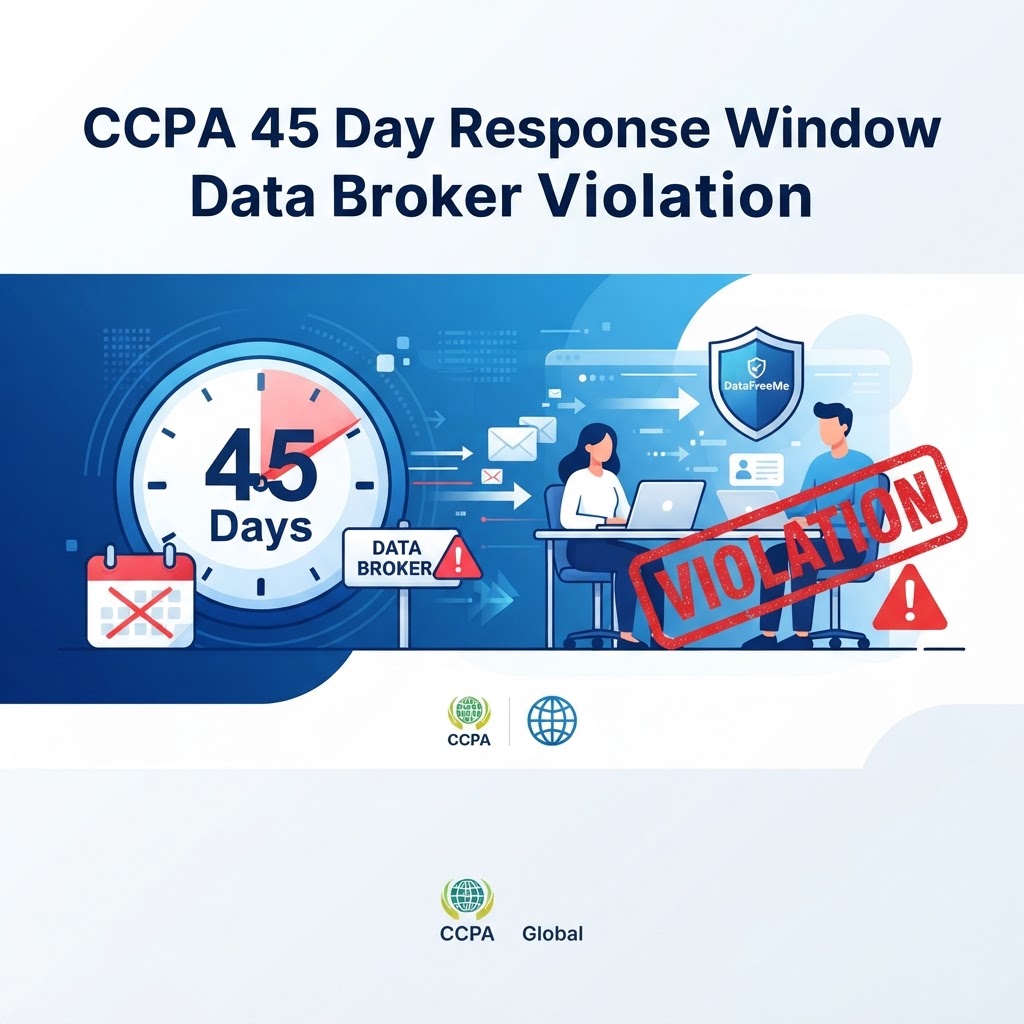
A CCPA 45 day response window data broker violation occurs when a business covered by the California Consumer Privacy Act fails to honor a verified deletion request within the statutory deadline. DataFreeMe is a global data security firm specializing in systematic, operational privacy defense, and we have found that data brokers often rely on consumer inertia to ignore these timelines.
Led by Stephen Sawyers, CEO of DataFreeMe. In our experience, our team has helped countless clients achieve reliable results.
As the CEO of DataFreeMe and a dedicated data security expert, I have spent years managing complex privacy campaigns for households. In my experience, privacy is not a passive activity; it is an operational project. When you submit a request under CCPA §1798.105, you are initiating a legal process that requires rigorous tracking. A CCPA 45 day response window data broker violation is unfortunately common because brokers treat non-compliance as a manageable business risk rather than a legal crisis.
How Do You Detect a CCPA 45 Day Response Window Data Broker Violation?
Detecting a violation requires you to move away from hoping for a response and toward active auditing. We specialize in helping users map their data footprint across 900+ data brokers. You cannot assume a request was honored just because you sent an email. If you haven't received a confirmation within the statutory 45-day window, you are likely witnessing a CCPA 45 day response window data broker violation.
To manage this effectively, you need a manual privacy opt out workflow. By maintaining a clean log of when you submitted each request, you gain the leverage to escalate non-compliance. If a broker forces you to jump through hoops, understand that they are optimizing for friction. For brokers that use forms, we suggest using our resources on why web-form brokers are harder than email brokers to cut down your processing time.
What Defines a Verifiable Consumer Request?
Under the CCPA, a deletion request must be "verifiable," meaning the business can reasonably confirm that the person making the request is the consumer about whom they collected information. This is often where brokers create obstacles. If you encounter hurdles, consult our Verifiable Consumer Request Requirements CCPA Guide to ensure your request meets the legal standard that forces a response.
A CCPA 45 day response window data broker violation is not just a delay; it is a failure to meet the statutory requirement set by the California Attorney General's office. You must treat every request like an audit. When a company ignores a valid request, you are entitled to file a formal complaint. For detailed steps on how to proceed, read our guide on how to file a complaint against a data broker.
Why Do Brokers Risk a CCPA 45 Day Response Window Data Broker Violation?
The primary reason brokers risk a CCPA 45 day response window data broker violation is that the cost of compliance is often higher than the cost of occasional regulatory scrutiny. They operate on a relational graph model, meaning your data is interconnected with your family members. If you ignore the rest of your household, your data will naturally drift back into the broker's database. This is why we advocate for tracking what data brokers actually know about your family to ensure total coverage.
When a broker misses the deadline, they are betting that you will move on. Don't. A CCPA 45 day response window data broker violation requires persistent follow-up. You should maintain a central spreadsheet that tracks the date of submission, the date of acknowledgment, and the date of verified deletion. If the 45-day mark passes, you have the evidence required to escalate the matter. For those looking for the legal framework governing these timelines, you can refer to the California Attorney General's official CCPA resources.
Consistent maintenance is key to preventing re-listing. Because these databases are dynamic, data will eventually reappear if you do not perform recurring audits. We recommend building a robust schedule for re-verification of your data broker opt outs to keep your privacy footprint minimal. By treating data privacy as an operational campaign, you can force brokers to respect your rights, even if they would prefer to ignore them.
Remember, your statutory rights are only as strong as your willingness to enforce them. If you suspect a CCPA 45 day response window data broker violation, document it, report it, and keep moving through your audit list. The goal is to make the cost of holding your data higher than the utility they derive from selling it. When you make yourself a difficult, persistent target, brokers are more likely to remove your records and move on to a less prepared subject.
FAQ
What is the CCPA 45 day response window?
The CCPA 45 day response window is the statutory period in which a business must respond to a verified consumer request for deletion, starting from the day they receive your request.
What should I do if a broker misses the 45-day deadline?
If a broker misses the deadline, it is a CCPA 45 day response window data broker violation; you should send a formal follow-up referencing your original submission date and, if they continue to ignore you, file a complaint with the California Privacy Protection Agency (CPPA).
How can I prove a company received my deletion request?
You prove receipt by keeping an audit trail, which includes saving copies of your sent emails, screenshots of submitted web forms, and any automated confirmation receipts you receive during the process.