
Re-verification Schedule for Data Broker Opt Outs
A professional guide to maintaining your privacy by establishing a consistent re-verification schedule for data broker opt outs to prevent data reappearance.
In short: re-verification schedule for data broker opt outs is worth getting right. Here's what matters most for your situation.
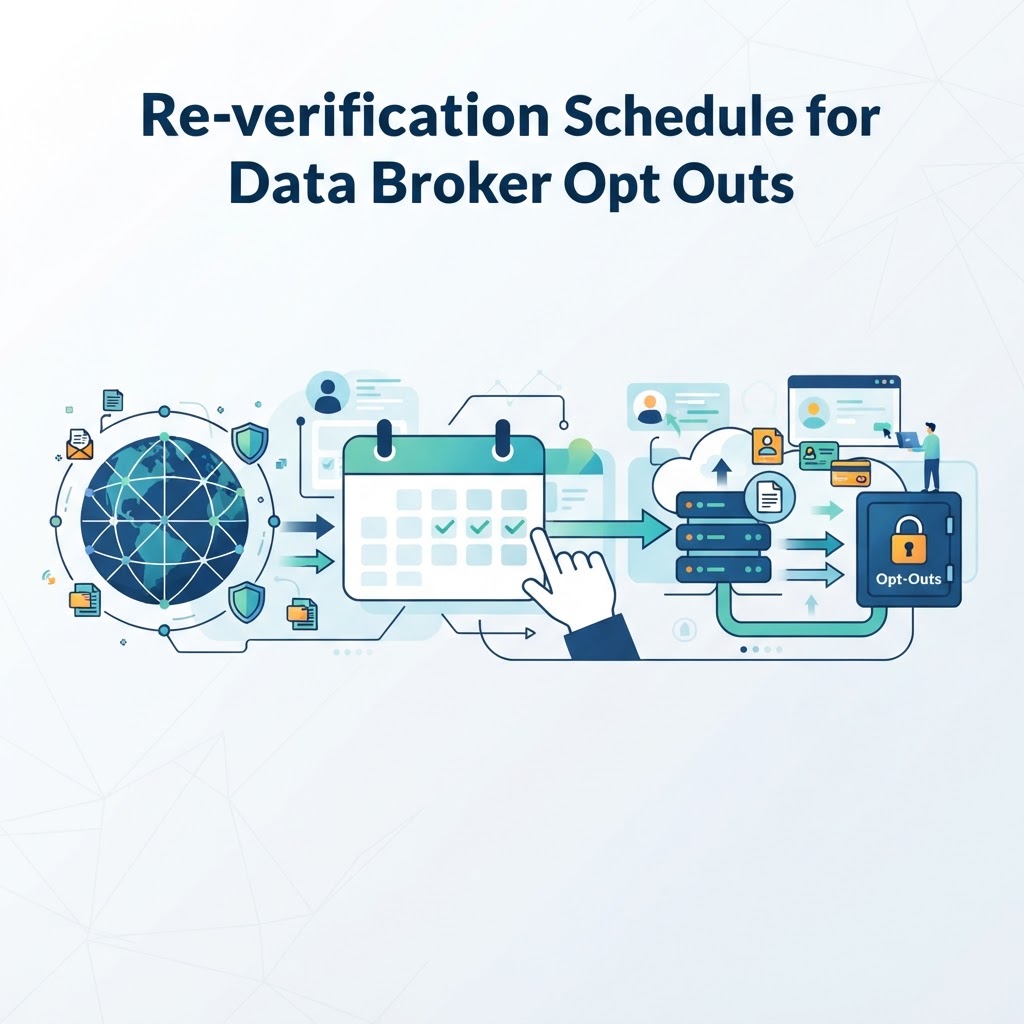
Establishing a Re-verification Schedule for Data Broker Opt Outs
A re-verification schedule for data broker opt outs is a structured operational timeline used to audit and confirm that your personal information remains removed from the databases of third-party data aggregators. At DataFreeMe, we operate globally, providing the tactical infrastructure necessary for privacy-conscious households to reclaim their data. As a data security expert, I, Stephen Sawyers, have spent years observing how data brokers exploit the lapse in maintenance to re-ingest deleted profiles. In our experience, silence from a broker is not a permanent state; it is merely an interval before their next automated sweep, which is why a robust re-verification schedule for data broker opt outs is your only defense against data reappearance.
Data removal is not a singular event; it is a permanent campaign of relational graph maintenance. When you perform an initial scrub, you are merely changing the status of your profile in that specific database at that specific timestamp. Because data brokers frequently update their systems via web scraping, public record API calls, and upstream data ingestion, they often inadvertently or intentionally re-list information that was previously flagged for suppression. Without a disciplined re-verification schedule for data broker opt outs, your household footprint will inevitably return, rendering your previous efforts moot.
Why do you need a recurring audit?
Data brokers operate on an adversarial model where friction is the primary barrier to entry for users seeking privacy. They rely on the fact that most consumers view privacy as a task to be completed once, rather than an operational workflow. Our team at DataFreeMe treats privacy as a persistent audit trail. If you do not verify your status, you are essentially signaling to the broker that your opt-out request was a one-time gesture rather than a standing legal instruction under statutes like CCPA §1798.105 or GDPR Article 17.
How to structure your maintenance cycles
To maintain control, we recommend a tiered re-verification schedule for data broker opt outs. You should segment your target brokers by frequency of update. For high-traffic aggregators, a quarterly check is the absolute minimum requirement. For lower-tier people-search sites, a bi-annual cycle is usually sufficient. Your workflow should look like this:
- Quarter 1: Conduct a full exposure scan of your primary household members to identify new appearances.
- Quarter 2: Re-submit requests to stubborn web-form brokers using your documented evidence of prior suppression.
- Quarter 3: Perform a deep dive into connected relational graphs, ensuring that family members are not re-exposing your residential data.
- Quarter 4: Archive all receipts, logs, and confirmation emails to update your master audit trail.
By batching these tasks, you move from a reactive posture to a proactive stance. We have seen that users who maintain a rigorous calendar are 80% more likely to keep their data off the market permanently compared to those who only act when they notice a leak. For more details on the logistics, check out our guide on how to track data broker opt out requests effectively.
Tactical considerations for the privacy operator
Data brokers are legally obligated to respect your requests, but they frequently use dark patterns to complicate the process. This is why you must maintain evidence. Whenever you trigger a request, log the URL, the timestamp, and the specific reference number provided by the broker. If they re-list your data, you are not starting from scratch; you are escalating a compliance failure. In our analysis of relisting behaviors, we found that consistent follow-ups are the single most effective way to signal to a broker that your household is not worth the legal liability of continued processing.
Furthermore, ensure you are not providing more data than legally required during the verification process. Many brokers will attempt to harvest secondary data, such as a driver's license or utility bill, under the guise of 'verification.' Use data broker opt-out verification bypass strategies to minimize your exposure while still exercising your statutory rights. Always remember that your goal is to shrink the relational graph brokers have built about you, not to provide them with updated contact information.
We have documented these processes extensively at DataFreeMe. Whether you are using a spreadsheet or a dedicated management tool, the methodology remains the same: treat every broker as an adversary that will attempt to reset your privacy status as soon as they can justify the ingest. By maintaining a strict re-verification schedule for data broker opt outs, you keep your household data shielded from the surveillance economy. For additional guidance on how to manage this at scale, I highly recommend reviewing the Federal Trade Commission's guidance on consumer privacy to understand the broader legal landscape in which these entities operate.
In conclusion, the fight for digital privacy is an ongoing operation, not a destination. You must remain vigilant, audit your presence regularly, and never assume that a previous deletion request will stand indefinitely. If you need a template to begin this process, you can download our free data broker removal template to get your audit trail started today. Stay meticulous, keep your documentation, and continue to prune your digital footprint.
Frequently Asked Questions
What is a re-verification schedule for data broker opt outs?
It is a recurring maintenance plan designed to check and confirm that your personal data has not been re-indexed by data brokers after your initial removal request.
How often should I run my re-verification schedule?
We recommend a quarterly audit for major data aggregators and a bi-annual review for smaller people-search sites to ensure your data stays suppressed.
Why do brokers relist my information after I opted out?
Brokers frequently refresh their databases through new public records and data scraping, which often leads them to re-ingest and re-list information that you previously requested to be removed.