
Household Personal Data Audit Checklist
Learn how to build a robust household personal data audit checklist to systematically remove your family's information from hundreds of data brokers.
In short: household personal data audit checklist is worth getting right. Here's what matters most for your situation.
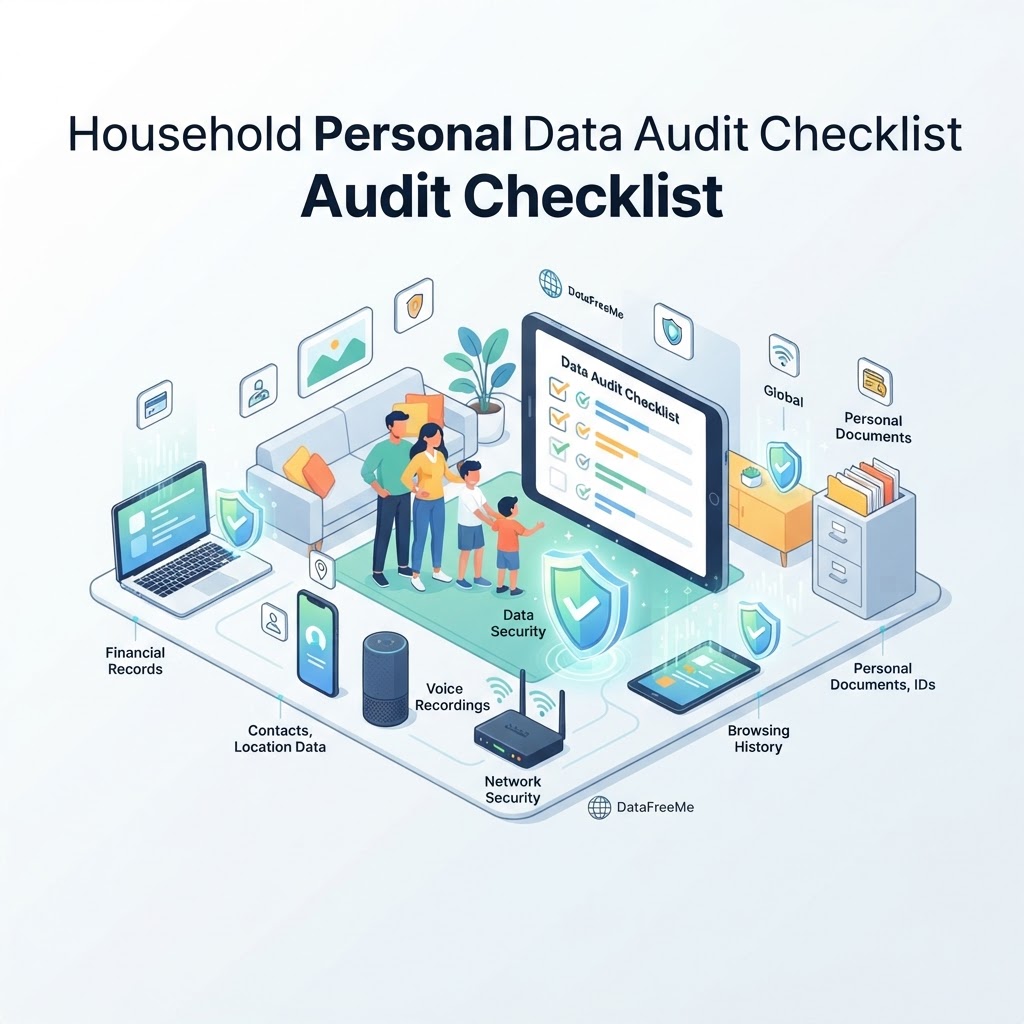
A household personal data audit checklist is a systematic operational procedure used to inventory, map, and prune the digital footprint of every family member across hundreds of interconnected data broker databases. At DataFreeMe, we specialize in helping individuals regain control of their household data globally, operating with the precision required to dismantle the relational graphs brokers build to link your family members together.
As a Data Security Expert with over 15 years of experience in privacy operations, I, Stephen Sawyers, have seen firsthand how individual opt-outs fail when the rest of the household remains exposed. If you ignore the relational links between family members, data brokers simply re-associate the information using shared addresses, last names, or phone numbers. Our approach is to treat your family’s digital footprint as a singular, manageable data graph, ensuring that when we request deletion under laws like CCPA §1798.105 or GDPR Article 17, it is done with the necessary authority to make it stick.
Why Do You Need a Household Personal Data Audit Checklist?
Data brokers do not view you as a private individual; they view you as a node in a massive, profit-driven relational graph. When you attempt to remove your own name from a people-search site, the system often triggers a re-indexing event that pulls your new information from your spouse or children’s public records. A proper household personal data audit checklist allows you to perform a comprehensive sweep of these connections simultaneously.
In our experience at DataFreeMe, manual opt-outs often fail because users lack a centralized log. You need an audit trail. Every time you submit a request, you must capture a timestamp, a reference number, and the specific statutory basis for the demand. Without this, you have no leverage when a broker ignores your request or, more commonly, silently re-lists your data after 30 to 90 days. We track 900+ data brokers because that is the scale of the adversary we are up against.
How to Execute Your Household Personal Data Audit
To begin your audit, you must first map the target area. Use our Free Data Broker Exposure Scan to identify which platforms are currently harvesting your family data. Once you have your map, follow these tactical steps:
- Inventory all household identifiers: List every email address, phone number, and physical address used by any family member in the last decade.
- Establish a central tracking log: Create a spreadsheet or use a dedicated tool to log the date of each request, the broker’s name, the link to the opt-out page, and the status of the request.
- Batch your requests by methodology: Distinguish between email-based brokers, web-form brokers, and those requiring manual verification to optimize your workflow. If you struggle with friction, read our guide on why web-form brokers are harder than email brokers.
- Enforce the 45-day rule: Under the California Consumer Privacy Act (CCPA), brokers generally have 45 days to comply with a verifiable request. If they miss this window, escalate your documentation immediately.
- Plan for recurring cycles: Data brokers refresh their databases continuously. Your household personal data audit checklist must include a recurring audit every 90 days to prune new entries.
By managing your household as a connected graph, as detailed in our guide on household data privacy management, you stop the bleeding at the source. If one relative remains exposed, the entire household remains exposed. You can learn more about how to systematically remove your entire family's personal information by visiting our detailed walkthrough on family member opt-outs.
How Do You Maintain Long-Term Privacy Hygiene?
Privacy is not a one-time project; it is an ongoing campaign. The goal is to make your personal information "costly" for data brokers to host. Every time you force a deletion, you create a "suppression record" within their system. To maintain this, you must be prepared to handle the bureaucratic pushback. Some brokers will use dark patterns to delay your request, demanding unnecessary documentation or creating infinite loops of verification.
You can find more information on these tactics at the California Attorney General’s website, which serves as a primary resource for understanding the legal weight behind your requests. Remember: you are not asking for a favor; you are exercising a statutory right. By keeping a meticulous, audit-ready log, you ensure that if a dispute arises, you have the proof of correspondence necessary to escalate to regulatory bodies if needed. If you are ready to take control, start by auditing your current exposure today and build your household personal data audit checklist into your standard quarterly digital maintenance.
Frequently Asked Questions
What is included in a household personal data audit checklist?
A comprehensive checklist includes a list of all household identifiers (emails, phones, addresses), a log of every data broker contacted, the specific statute cited (like CCPA §1798.105), a status column for tracking, and a scheduled date for 90-day follow-up audits.
Why do my family members re-expose my personal data?
Data brokers link profiles based on relational data. If a family member remains un-opted, their records often include your shared address or phone number, which allows the broker to re-link and re-publish your profile automatically.
How often should I run a data broker audit?
We recommend a full household audit every 90 days. Data brokers constantly crawl public records and refresh their databases, meaning your footprint can reappear even after you have successfully requested deletion.