
How to Opt Out Family Members From Data Brokers
Learn how to systematically remove your entire family's personal information from data brokers by managing your household as a connected data graph.
In short: how to opt out family members from data brokers is worth getting right. Here's what matters most for your situation.
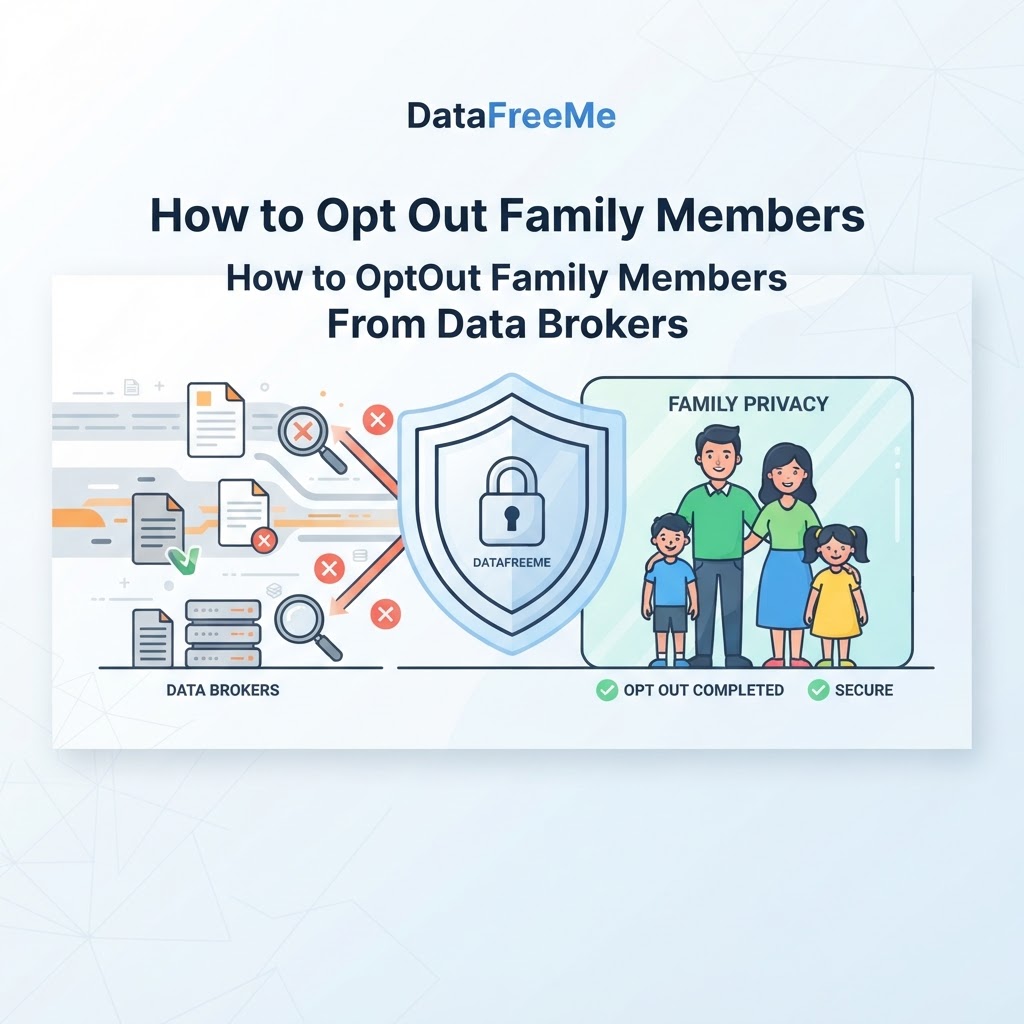
To effectively opt out family members from data brokers, you must treat your household as a single, interconnected data graph and execute systematic removal requests for every individual simultaneously. At DataFreeMe, we provide a global platform dedicated to helping you map these relationships and prune your digital footprint, ensuring that a single unmanaged relative does not keep re-exposing your entire household to surveillance capitalism.
Led by Stephen Sawyers, CEO of DataFreeMe.
As the CEO of DataFreeMe and a dedicated data security expert, I have spent years witnessing how brokers exploit the relational nature of family connections. My team and I specialize in the operational mechanics of data removal, helping users navigate the complex landscape of CCPA and GDPR compliance to regain control of their personal information. If you are wondering how to opt out family members from data brokers, understand that it requires more than just clicking a button; it requires an audit-driven, persistent workflow.
Why Is Household Data Privacy Management Critical?
Data brokers do not just track individuals; they build identity graphs. When you remove your own name from a site but leave your spouse or child's data active, the broker's algorithm can often re-link your household through shared addresses, voter registration records, or utility bill metadata. True privacy is an operational campaign that must be conducted at the household level. We have found that the only way to break this cycle is through rigorous household data privacy management.
In our experience, failing to manage family members leads to a "zombie profile" phenomenon where data seemingly deleted reappears within weeks. This happens because brokers refresh their databases periodically, pulling from disparate public records. To prevent this, you need to treat each family member as a node in your removal operation. By mapping every relative against our directory of over 900 data brokers, you ensure that no "relational anchor" remains to allow the broker to reconstruct your home profile.
How to opt out family members from data brokers effectively
The process of opting out family members involves several technical steps that go beyond simple web forms. First, you must identify every member of your household who has a digital presence. Second, you must determine which broker sites are specifically targeting your family's relational data. Finally, you must issue and track removal requests with the discipline of an IT operator.
- Map the Graph: Identify the names, previous addresses, and contact info of all family members.
- Audit the Brokers: Use a tool like our Free Data Broker Exposure Scan to see which brokers currently host data for your family members.
- Execute Statutory Requests: Cite the specific legal framework, such as CCPA §1798.105 or GDPR Article 17, in your correspondence.
- Log the Receipts: Maintain a strict audit trail. If a broker ignores a request, you need documented proof of the original submission to escalate the complaint.
We believe that silence is not compliance. When you demand the deletion of personal information, you are enforcing a statutory right. For a more detailed breakdown of these legal mechanisms, you can refer to Data Broker Statutory Deletion Rights Explained.
What are the primary challenges when managing family opt-outs?
One of the biggest hurdles is the prevalence of "dark patterns" and intentional friction designed to discourage removal requests. Many brokers intentionally break their opt-out forms, demand unnecessary driver's license copies, or set up circular verification loops. We have documented these tactics extensively at DataFreeMe. You can learn more about identifying these UI traps by reading our guide on Identifying Data Broker Dark Patterns.
Furthermore, managing the volume of requests for a family can be overwhelming. Tracking 50, 100, or 600+ opt-outs for an entire household requires a systematic approach to avoid losing track of deadlines. We recommend creating an operational data broker deletion audit trail to manage follow-ups. This is the only way to ensure that you are actually meeting the 45-day response windows mandated by many state privacy laws.
For more information on how data brokers themselves operate, you can visit the Federal Trade Commission's guide on data brokers. Understanding the adversary is the first step in successful privacy maintenance.
FAQ
How do I know if my family's data is on these sites?
You can use a free data broker scan to see a snapshot of which brokers have your family's names and addresses in their databases. This audit helps you prioritize which brokers to target first based on their reach.
Is it legal for brokers to require my ID?
Many brokers ask for IDs as a friction tactic; however, legally, they must provide a way to verify your identity without compromising sensitive documents. Always check local statutes to see what is required for a verifiable consumer request.
How often should I re-check for deleted data?
Data brokers refresh their records frequently, often every 30 to 90 days. We recommend setting a recurring audit in your spreadsheet to verify that your family's data has not been re-indexed by aggregators.
The fight for digital privacy is an ongoing operation. By treating your family's data as a secured asset and following through with rigorous, document-backed requests, you can significantly reduce your household's exposure. Start your audit today and take control of your digital identity.