
Household Data Privacy Management: The Tactical Guide
Learn how to treat your family’s digital footprint as a single, manageable data graph to effectively remove your presence from data brokers.
In short: household data privacy management is worth getting right. Here's what matters most for your situation.
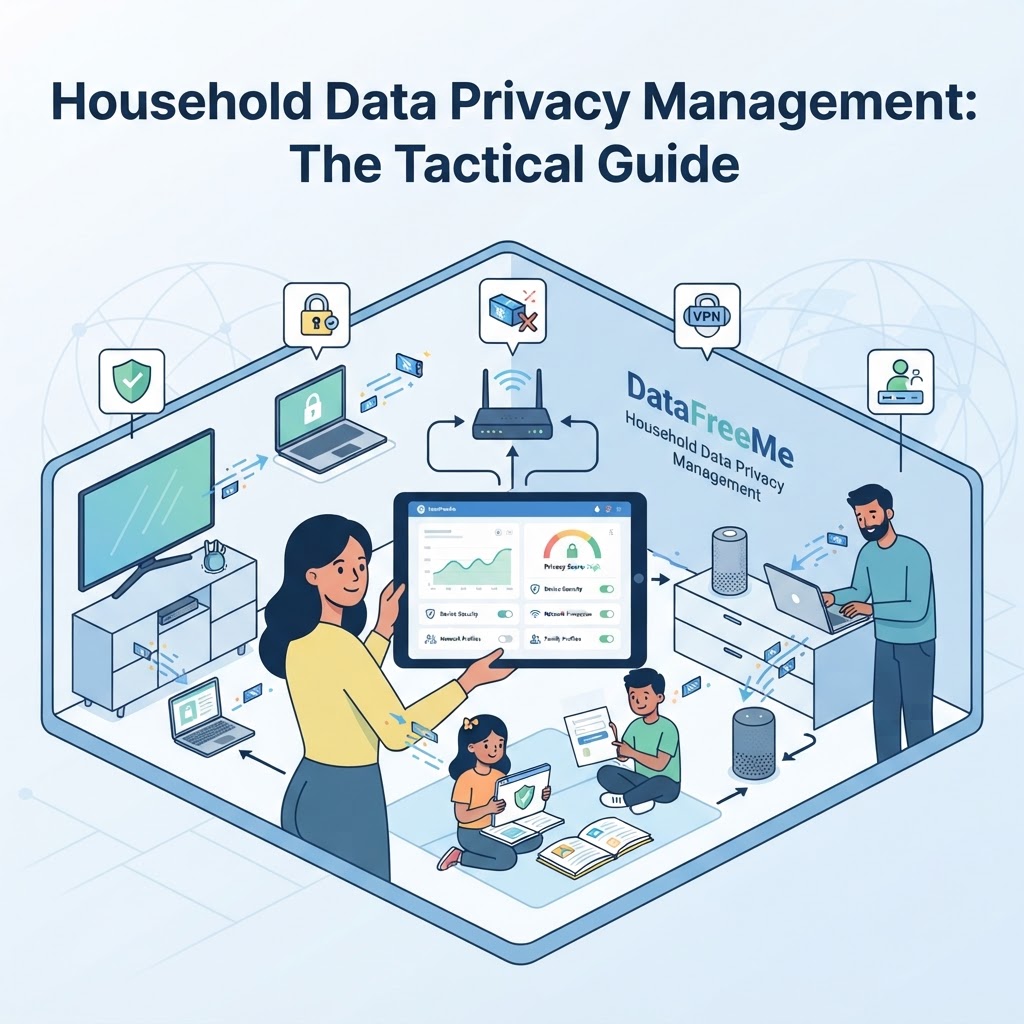
Effective household data privacy management is the practice of treating your family’s digital footprint as a unified, relational data graph that must be systematically pruned to minimize exposure across hundreds of data brokers. At DataFreeMe, we specialize in providing global consumers with the operational tools needed to enforce statutory deletion rights, ensuring that your household remains an uninteresting target for automated surveillance capitalism. I am Stephen Sawyers, CEO of DataFreeMe, and as a data security expert, I have spent years tracking how brokers exploit family links to keep profiles alive. In our experience, privacy is not a passive setting; it is a rigorous, ongoing operational campaign.
When we talk about household data privacy management, we mean more than just clearing browser cookies. It involves a systematic audit of how data brokers link family members through shared addresses, utility records, and voter registrations. If you opt out yourself but leave your spouse or children unmanaged, the broker's identity resolution engine will simply re-link your data, effectively nullifying your effort. Our team has developed strategies to combat this, helping you move from reactive confusion to proactive suppression.
Why is household data privacy management essential for your family?
Data brokers operate as large-scale information aggregators that profit from the relational connections between individuals. Because they utilize complex algorithms to associate relatives, a single point of failure in your household—like an unmanaged family member—can lead to the entire group being re-indexed. When you implement a comprehensive household data privacy management strategy, you are effectively performing 'graph shrinkage,' systematically removing the nodes that allow brokers to reconstruct your digital identity.
In our practice, we have observed that silence is often interpreted by brokers as consent to continue harvesting. To counter this, we advocate for a procedural approach using tools found at DataFreeMe. By tracking every request as an audit log, you create a trail of accountability that brokers are legally obligated to respect under statutes like CCPA §1798.105.
How do you manage deletion requests for a whole household?
Managing the records of multiple individuals requires a shift toward batching and standardization. The friction introduced by data brokers, such as forcing users through opaque web forms, is a deliberate design choice meant to deter you. We suggest the following operational workflow:
- Map the household: Document every name, previous address, and phone number associated with every family member.
- Audit the directory: Utilize our Free Data Broker Exposure Scan to identify which of the 900+ brokers are holding your data.
- Standardize requests: Use clear, legally cited language to invoke your right to erasure, whether that be through GDPR Article 17 or state-level protections.
- Log the receipts: Treat every opt-out request as a transaction requiring a confirmation receipt. If a broker fails to respond within the 45-day statutory window, the log becomes your evidence for further action.
For those looking to streamline their efforts, our guide on tracking 600+ opt-outs provides a blueprint for maintaining sanity while navigating this complex process. By treating each removal as a verifiable consumer request, you significantly increase the success rate of your deletions.
What are the legal boundaries of data broker requests?
Understanding your statutory rights is the most powerful tool in your arsenal for household data privacy management. Brokers often employ 'dark patterns'—UI traps designed to confuse the user into abandoning their request—but these do not supersede your legal rights. According to the California Office of the Attorney General, businesses must provide clear methods for consumers to opt out of the sale of their personal information.
We have found that being persistent is key. Many brokers will attempt to verify your identity by asking for sensitive documents, such as a driver's license. Our stance is clear: you should minimize the data you provide to these entities. If you are struggling with a specific broker, ensure you are referencing the correct legal citations in your communications. A well-constructed, firm request that cites specific statutes is much harder for a legal team to ignore than a generic complaint.
Remember that your household is a single entity in the eyes of these brokers. Successful household data privacy management is about removing the links that allow them to perform identity resolution. If you stop the 'relational leakage' by proactively cleaning the records of your entire family, you drastically reduce the surface area for automated tracking. It is a long game, but one that is entirely winnable with the right audit trail and tactical persistence.
Start your journey today by auditing your current footprint. For more advanced techniques, read our detailed breakdowns on identifying data broker dark patterns and securing your property records. Constant vigilance and structured workflows will ensure that your family’s information remains private, secure, and under your control.
FAQ
What is household data privacy management?
Household data privacy management is a systematic operational approach to pruning personal information from the relational graphs that data brokers use to track families. It involves identifying all household members' records across hundreds of directories and executing batch removal requests to minimize the overall data footprint.
Why is it important to opt out the entire household?
Data brokers use identity resolution algorithms to link individuals through shared addresses and family records. If you only remove your own data, brokers can often reconstruct your profile using the public data points of your family members, keeping your records active in their databases.
How long does it take for a broker to honor an opt-out?
Under many privacy laws, such as the CCPA, brokers are typically required to respond to or act upon verified consumer deletion requests within 45 days. Maintaining a precise audit log of these requests allows you to track whether they are meeting this statutory deadline.