
Verifiable Consumer Request Requirements CCPA Guide
Learn how to master verifiable consumer request requirements under the CCPA to effectively force data brokers to delete your household's sensitive information.
In short: verifiable consumer request requirements CCPA is worth getting right. Here's what matters most for your situation.
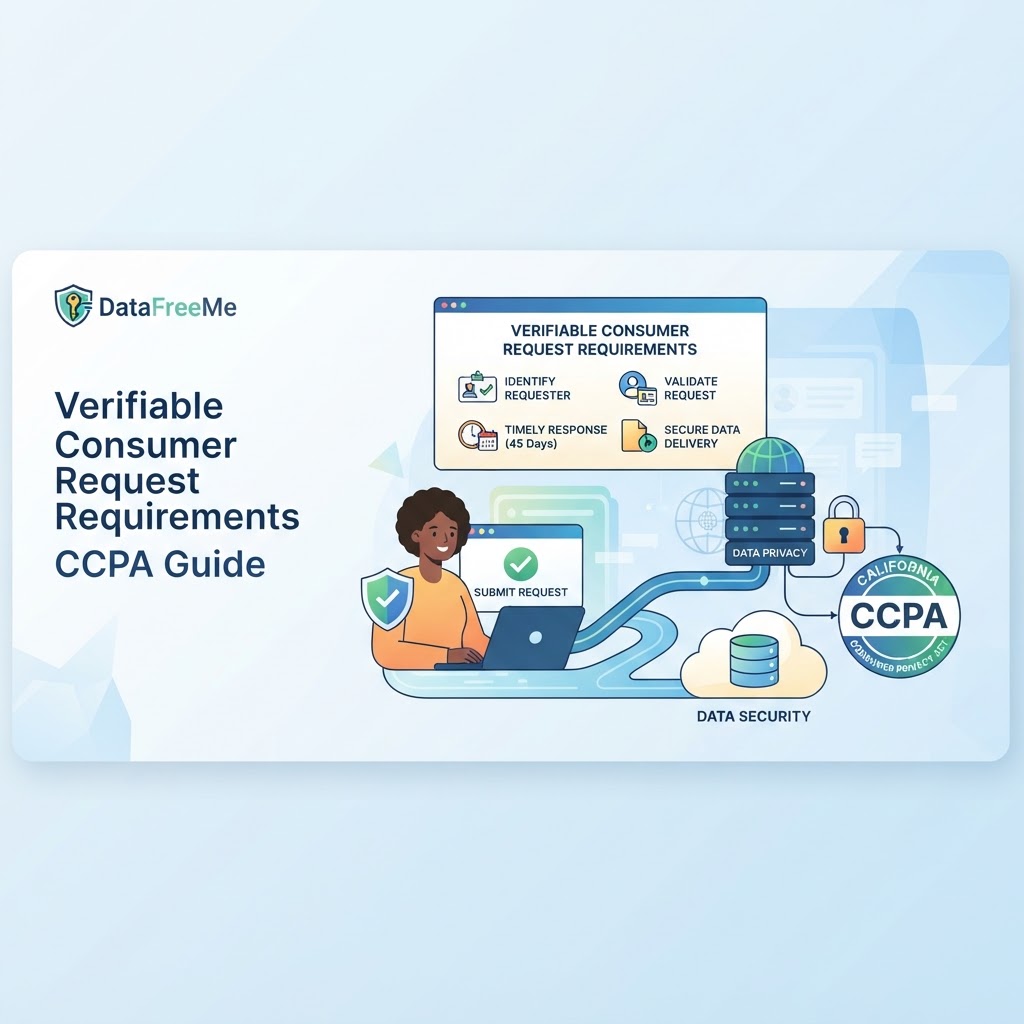
Verifiable Consumer Request Requirements CCPA Guide
A verifiable consumer request requirement under the CCPA is the specific legal mechanism by which a business must confirm your identity before processing a request to delete, know, or correct your personal data. At DataFreeMe, based globally, we specialize in helping household heads systematically manage these requests to shrink their relational data footprint across 900+ brokers. My name is Stephen Sawyers, and as a data security expert, I have learned through years of operational experience that understanding the nuance of verifiable consumer request requirements CCPA standards is the only way to overcome the bureaucratic friction brokers use to stall your privacy rights.
This guide is current for 2026.
When you submit a request, the CCPA does not allow brokers to invent arbitrary hurdles. However, they often hide behind vague interpretations of verification to keep your data in their ecosystem. To effectively reclaim your privacy, you must understand that the CCPA balances your right to delete with the business's need to prevent unauthorized access to someone else's sensitive information.
What Are the Core Verifiable Consumer Request Requirements CCPA Standards?
The California Consumer Privacy Act (CCPA), as amended by the CPRA, mandates that businesses establish secure procedures to verify that the person making a request is indeed the consumer associated with the data. In our experience at DataFreeMe, most friction points are intentional; they are designed to exhaust the average user. When you look at the verifiable consumer request requirements CCPA guidelines, they generally require the business to use a standard of verification that is proportionate to the sensitivity of the data.
For example, if you are requesting that a broker delete your entire household's relational graph—which we cover extensively in our guide on what data brokers know about your family—the level of verification should be consistent with the risk of potential harm. If the information is publicly available, the threshold for verification should be lower than if you are requesting access to highly sensitive private records.
Why Do Data Brokers Make Verification Difficult?
Data brokers operate on the premise of information asymmetry. They want to know everything about you while making it impossible for you to know what they know, let alone force them to delete it. When you trigger the verifiable consumer request requirements CCPA protocols, brokers often ask for government-issued IDs, utility bills, or excessive personal details as a form of "identity verification." This is frequently a delay tactic. Our team often finds that if you cite the California Attorney General’s CCPA guidelines, you can often bypass these excessive requests by proving identity through other, less invasive means, such as confirming recent transaction history or specific contact information already on file.
Successfully managing this requires a rigorous audit trail. If you are not logging your requests, you are essentially flying blind. We advocate for a strategy where you treat every request as an IT operation: log the timestamp, the specific method of delivery, the confirmation receipt, and the deadline for the 45-day window. If you are struggling to keep track of these interactions, our guide on tracking opt-outs provides the necessary tactical framework to stay organized.
How to Maintain a Verifiable Audit Trail for Privacy Requests
To ensure your verifiable consumer request requirements CCPA enforcement holds weight, you need to maintain a persistent record. Businesses are required to respond within 45 days, with a possible 45-day extension if they notify you. If they fail to comply, your documented audit trail becomes the primary evidence used when filing a complaint. As discussed in our guide on filing complaints against data brokers, having a timestamped, serialized record of your communications is non-negotiable. Do not rely on web forms that provide no confirmation; prioritize email requests where you possess a digital paper trail.
Many users fail because they treat privacy as a one-time event. Privacy is a maintenance cycle. Every time a new data broker emerges or an existing one scraps your data from public records, the process resets. By adhering to the verifiable consumer request requirements CCPA, you hold the leverage. If you feel overwhelmed by the volume of requests, consider the workflow principles in our article on the best manual data broker removal workflow. This process transforms a chaotic list of 900+ entities into a manageable, batchable pipeline of requests that you can verify and track over time.
Establishing Long-Term Privacy Hygiene
The goal of understanding verifiable consumer request requirements CCPA is not just to delete one entry, but to systematically prune your family’s digital footprint. Because data brokers utilize relational databases, failing to opt out one family member often results in the rest of the household’s records being repopulated through association. We have built our systems at DataFreeMe to address this specifically. By mapping your household and applying consistent, verifiable requests, you create a "privacy wall" that is difficult for automated crawlers to penetrate without triggering a re-verification alert.
Remember that brokers are businesses, not government entities. They will only stop if the cost of compliance (or the risk of statutory penalties) outweighs the profit they generate from selling your data. When you provide the correct, minimal information required for a verifiable consumer request requirements CCPA submission, you demonstrate that you are a "hard target." They would prefer to focus on the "soft" targets who provide too much information or give up after one failed form submission. Stay the course, keep your logs clean, and maintain your, and your family's, right to be forgotten.
FAQ
What defines a "verifiable consumer request" under the CCPA?
A verifiable consumer request is a request made by a consumer that the business can reasonably verify as coming from the individual whose data is the subject of the request. The business must use a commercially reasonable method to match the information you provided with the data they already hold in their system.
Can a broker force me to send a scan of my driver's license?
In most cases, no. While they may ask for identification to comply with verifiable consumer request requirements CCPA standards, they cannot force you to provide more sensitive information than is necessary to verify your identity. You can often redact sensitive information, such as your license number or photo, provided you keep your name and address visible for verification.
What should I do if a broker claims they cannot verify my identity?
If a broker claims they cannot verify your identity, request that they provide the specific reason and the criteria they are using. If their demands seem excessive, cite the CCPA requirements that verification must be proportionate to the nature of the data, and escalate the issue to the relevant regulatory authority if they continue to block your legal right to deletion.