
Data Broker Statutory Deletion Rights Explained
Learn how to enforce your data broker statutory deletion rights through rigorous operational tracking and clear legal citations to reclaim your household privacy.
In short: data broker statutory deletion rights is worth getting right. Here's what matters most for your situation.
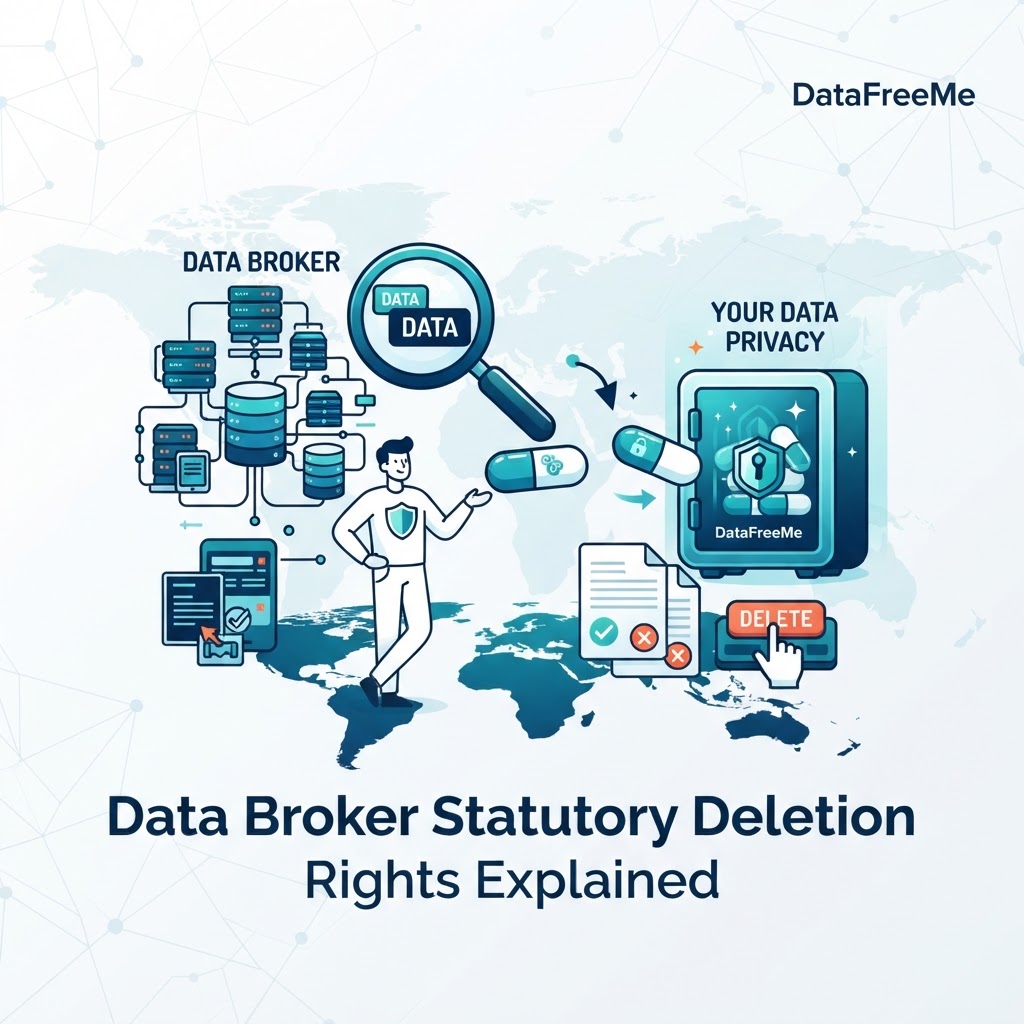
At DataFreeMe, we serve a global audience, helping individuals and families reclaim their digital autonomy from the pervasive surveillance economy. As the CEO and a data security expert, I, Stephen Sawyers, often emphasize that true privacy is not a passive state but an operational campaign. Understanding your data broker statutory deletion rights is the first line of defense in shrinking your household's digital footprint. In our experience, these rights function as legal levers; when exercised with precision and documented through a rigorous audit trail, they force compliance from even the most recalcitrant data brokers.
Data broker statutory deletion rights refer to the legal mandates provided by frameworks like CCPA §1798.105 and GDPR Article 17, which require companies to purge personal information upon a verified consumer request. Effectively managing these requests requires more than just checking a box; it requires treating your household as a connected data graph and maintaining a log of every interaction. At DataFreeMe, we specialize in helping you map your family against over 900 brokers, ensuring that your household data graph is pruned consistently and legally.
How Do You Enforce Data Broker Statutory Deletion Rights?
Enforcing these rights is not a one-time event; it is a systematic operation. Many brokers rely on friction—such as broken web forms, convoluted opt-out paths, or intentional delays—to discourage you from completing the process. To succeed, you must move beyond casual requests and adopt a formal, trackable workflow.
The Operational Workflow for Verifiable Requests
To ensure your data broker statutory deletion rights are honored, you must treat each request as a verifiable consumer request. This involves several critical steps:
- Map the Landscape: Use a tool like our free data broker exposure scan to understand which of the 900+ entities are tracking you.
- Establish an Audit Trail: For every request, log the timestamp, the method of communication, and the confirmation receipt.
- Cite the Law: Clearly reference the relevant statute, such as CCPA §1798.105 or GDPR Article 17, in your correspondence.
- Batch and Follow-up: Track your requests in a central repository, and if a broker fails to confirm within the mandatory window, initiate a follow-up process immediately.
We have found that maintainability is the biggest hurdle for most households. By batching your requests and using a structured tracking system, you prevent the re-exposure of household data that often occurs when family members remain unmanaged in these databases.
Why Are Data Broker Statutory Deletion Rights Often Ignored?
Data brokers operate on the principle of "intentional friction." They build their business model on the assumption that you will give up before you complete the opt-out process. Many brokers are effectively using dark patterns to hide the exit path or make the verification process overly burdensome. When you understand that these companies are essentially adversaries to your privacy, the need for an audit-first approach becomes clear. If a broker does not respond within their legal window—often 45 days in California—your documentation serves as the evidence needed for a formal complaint to regulatory bodies.
Maintaining this level of rigor requires time and technical literacy, but it is the only way to ensure your digital presence is truly minimized. DataFreeMe is built to support this mission by providing the tools you need to act as your own privacy operator. By automating the tracking of your data broker statutory deletion rights, we turn a daunting administrative burden into a manageable, transparent process. Remember, silence is not compliance. You must be proactive, persistent, and precise in your demands for data removal. Start by auditing your current footprint today to see which brokers have already indexed your household.
Conclusion
Your personal data is your property, and you have the statutory right to control it. Do not let data brokers dictate your level of privacy through administrative inertia. By leveraging clear legal citations and a disciplined tracking workflow, you can successfully prune your household footprint. Start your journey toward greater digital sovereignty by visiting DataFreeMe and taking control of your data today.
FAQ
What are data broker statutory deletion rights?
These are legal requirements under laws like the CCPA and GDPR that compel data brokers to delete personal information about an individual when a valid request is submitted. They provide a clear regulatory framework to force companies to remove your profile from their systems.
How long do brokers have to comply with my deletion request?
Under the California Consumer Privacy Act (CCPA), brokers generally have up to 45 days to respond to a verifiable consumer request. However, this period can sometimes be extended if the broker provides a valid, documented reason for the delay.
Why should I manage my family's data as a graph?
Data brokers use relational data to link household members, meaning if you delete yourself but leave a spouse or child on the broker's site, your information can often be re-linked. Managing your entire household as one data graph is the only way to ensure total removal.