
Is a Data Broker Requesting ID for Opt Out Legal?
When a data broker requests your ID for an opt-out, it is often a tactic to create friction. Learn how to legally challenge these requests effectively.
In short: data broker requesting id for opt out legal is worth getting right. Here's what matters most for your situation.
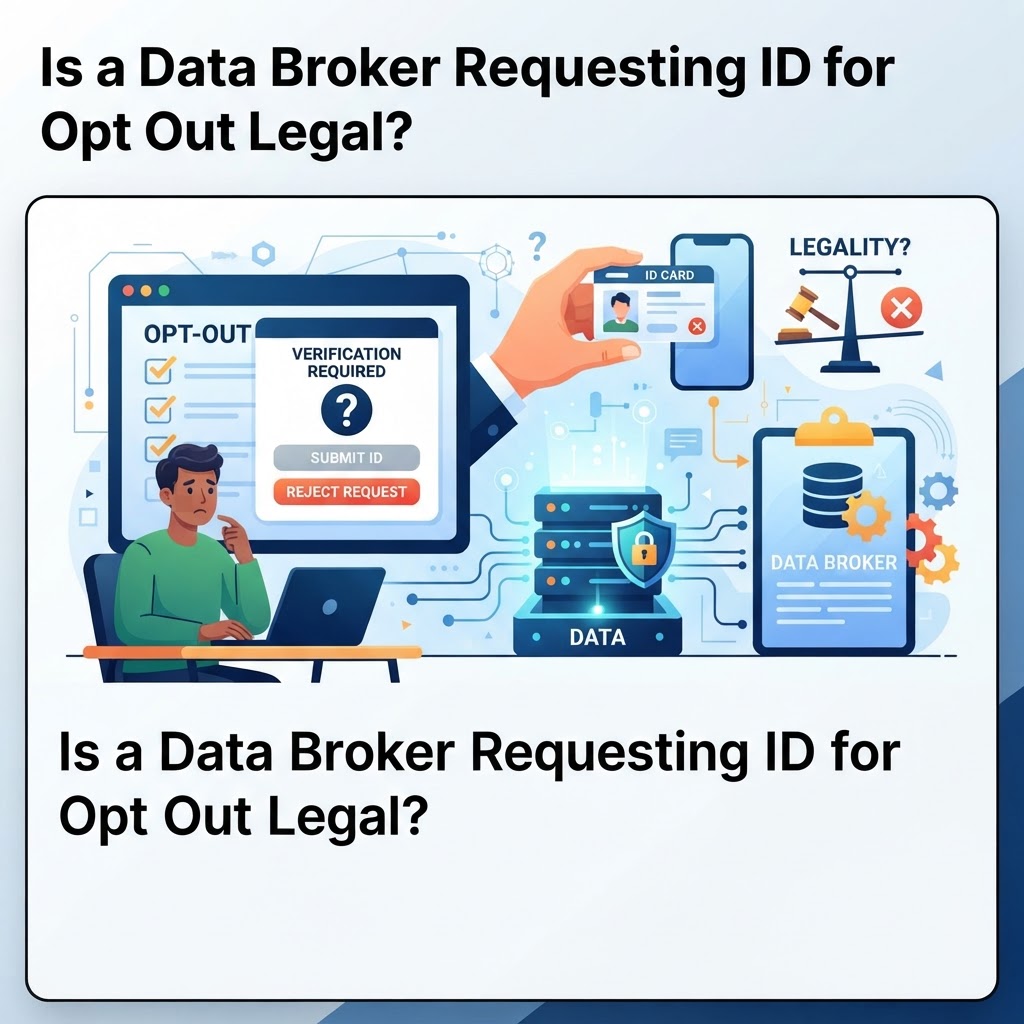
When you attempt to scrub your household from surveillance databases, you may hit a wall: a data broker requesting ID for opt out legal compliance verification. At DataFreeMe, we specialize in helping individuals systematically reclaim their digital footprint from over 900+ data brokers across the globe. As a Pragmatic Privacy Operator, I, Stephen Sawyers, have spent years navigating these hurdles. I can tell you that while brokers frequently demand government-issued IDs, this practice is often a deliberate form of friction rather than a statutory necessity.
DataFreeMe is a Data Security business, Global, specializing in Data Security. Data Security Expert.
To understand the legality of this demand, we must look at the specific frameworks governing data rights. Under statutes like the California Consumer Privacy Act (CCPA) §1798.105 and GDPR Article 17, you have the right to request the deletion of your personal information. However, brokers often use the "verification" requirement of these laws to force users into surrendering even more sensitive data. They argue that they must ensure the person requesting deletion is indeed the data subject, but in our experience, a redacted utility bill or a masked email address is often sufficient proof, while a full driver’s license scan creates a new, high-value security risk for you.
Is a data broker requesting ID for opt out legal under current privacy statutes?
The short answer is: it depends on the jurisdiction and the data sensitivity. Most privacy laws, such as the CCPA, require that a business takes reasonable measures to verify the identity of the requestor. However, the law does not explicitly mandate a government-issued ID as the exclusive method of verification. A data broker requesting ID for opt out legal justification often overreaches by design, hoping that the privacy-conscious individual will simply give up when faced with the requirement to upload a photo of their ID.
We have found that excessive data collection at the point of deletion is a classic dark pattern. By requiring an ID, the broker effectively keeps a record of you even as they ostensibly remove your other data. You must weigh the risk of sharing your ID against the goal of suppression. We recommend checking our Data Broker Opt Out Verification Process Explained to understand what information is truly necessary for identity proofing.
How should you handle a data broker requesting ID for opt out legal verification?
If you encounter a site that refuses to process your request without a scan of your passport or driver's license, you do not have to comply blindly. Here is our tactical workflow for handling these requests:
- Redact Everything: If you must submit an ID, use a photo editing tool to black out everything except your name and address. Cover the ID number, signature, and photograph. Most reputable brokers will accept this as valid proof of residency.
- Cite the Statute: Explicitly state that you are making a verifiable consumer request under CCPA §1798.105. Inform them that your identity has been verified through your registered email and address, and that providing a government ID is unnecessary for this transaction.
- Audit and Log: Keep a record of their demand. If they maintain that an ID is required, log it in your Data Broker Removal Template. When you eventually file a complaint, having documentation of their unreasonable request is vital.
- Use Alternative Verification: Suggest using a utility bill or a bank statement with the account numbers blocked out. This is often the path of least resistance for brokers.
For more on managing your digital presence across the web, review our guide on Masking Personal Email for Data Broker Opt Outs. This strategy adds a layer of protection by ensuring that the communication channel itself isn't a vector for further tracking.
Why do brokers insist on ID-based verification?
Data brokers operate on the premise that they are "verifying" the request to protect your privacy from third-party bad actors. In reality, they are often building a more robust profile of you. When a user is confronted with a data broker requesting ID for opt out legal hurdles, they often abandon the process entirely. This is exactly what the broker wants: silence is their default state. According to the California Attorney General's Office, businesses must allow consumers to exercise their rights, but they must not use the verification process as an excuse to collect unnecessary data.
We recommend conducting a Free Data Broker Exposure Scan to see just how many brokers are holding your data. Once you understand the scale of your household's exposure, you can approach the removal process as an operational campaign rather than an emotional struggle. You are essentially conducting "relational graph shrinkage"—reducing the nodes that connect you and your family to these commercial databases.
If a broker persists in requiring your ID despite your offer of alternative proof, refer them to the relevant section of their own privacy policy regarding "Data Minimization." You can also learn more about the broader strategy of managing household data by reading our entry on How to Opt Out Family Members From Data Brokers. By managing your household as a single entity, you reduce the surface area that these brokers can exploit to re-link your family's records.
The process of opting out is not a "one-and-done" event. Because these databases are constantly being re-populated from upstream sources, you must adopt a persistent audit trail. If you are ever stuck, remember that filing a formal complaint is a valid legal tool. Our guide, How to File Complaint Against Data Broker Effectively, provides the necessary steps to hold these entities accountable when they hide behind broken forms or excessive data requests.
Ultimately, when faced with a data broker requesting ID for opt out legal verification, stay calm and treat it as a technical obstacle to be cleared. You have the right to demand that they minimize the data collected during the opt-out process. Keep your audit logs, track your timestamps, and remain consistent. Your household's digital privacy is a continuous operations problem, not a one-time fix. By maintaining this rigour, you ensure that your data is not just hidden today, but scrubbed indefinitely.
Frequently Asked Questions
Is it mandatory to provide a driver's license for a data broker opt-out?
Generally, no. While brokers often demand government-issued IDs for verification, most privacy laws only require that a business uses reasonable methods to verify the identity of the person making the request. You can often offer less intrusive alternatives, such as a redacted utility bill.
What is the best way to handle a broker that insists on seeing my ID?
If a broker demands an ID, try submitting a heavily redacted version where all sensitive info like your license number, signature, and photo are blacked out. If they refuse, explicitly cite your rights under CCPA or GDPR and state that you have provided sufficient proof of identity.
Why do data brokers ask for my ID when I try to delete my data?
Brokers often use ID requests as a form of friction to discourage people from finishing the opt-out process. They may also use the information collected during the 'verification' step to further enrich or confirm their records of you.