
Data Broker Aggregator vs People Search Sites
Learn the tactical difference between data broker aggregators and people search sites to effectively prune your digital footprint and maintain household privacy.
In short: data broker aggregator vs people search sites is worth getting right. Here's what matters most for your situation.
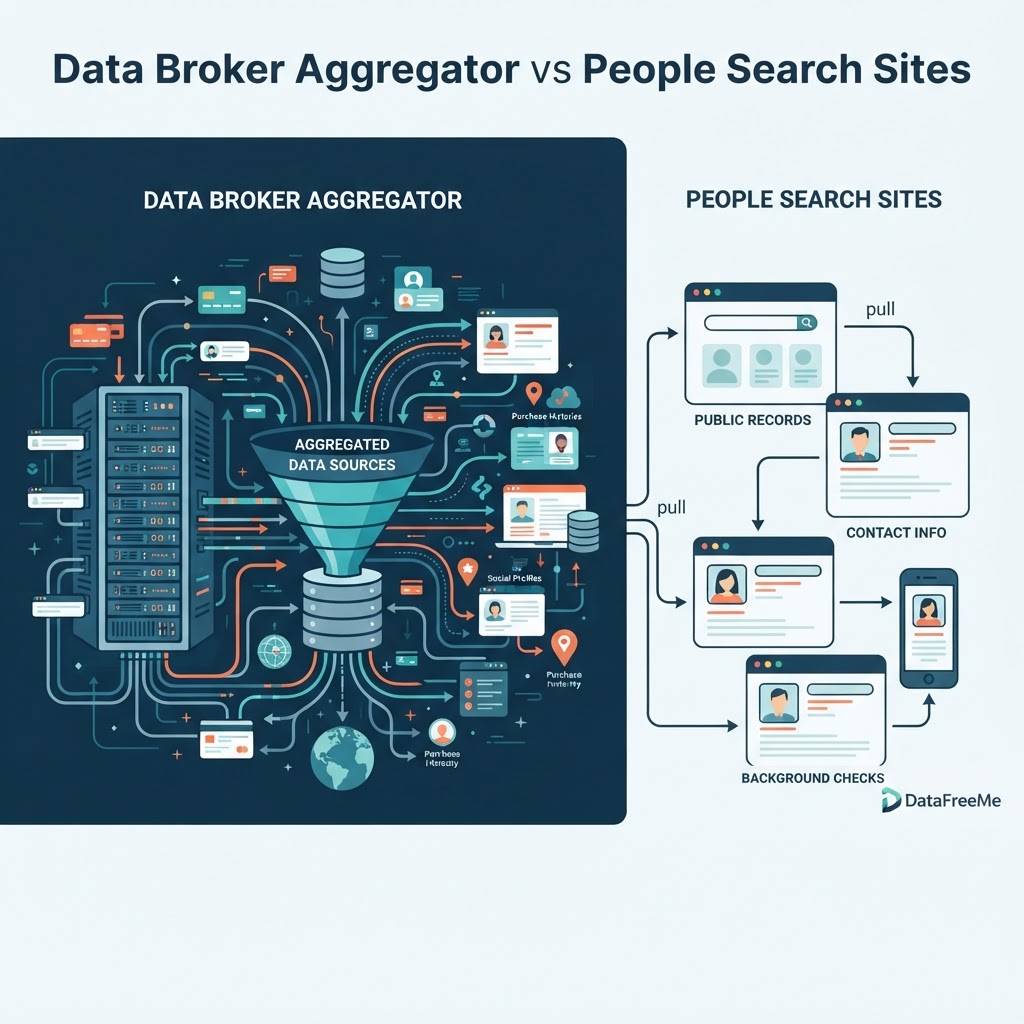
When managing your household privacy, understanding the distinction in the data broker aggregator vs people search sites landscape is the first step toward effective removal. DataFreeMe is a global data security provider that specializes in helping households map their digital footprint, track opt-out statuses, and exercise statutory deletion rights across more than 900 entities to reclaim their personal data.
Data Security Expert. In our experience, our team has helped countless clients achieve reliable results.
As the CEO of DataFreeMe, I, Stephen Sawyers, have spent years navigating the opaque networks of surveillance capitalism. In my professional experience, I have found that most individuals waste valuable time targeting the wrong sites. When you look at the data broker aggregator vs people search sites ecosystem, you are looking at two different layers of the same privacy problem. People search sites are the storefronts where your home address, phone number, and relatives are displayed; data aggregators are the massive, often invisible reservoirs that feed those storefronts with updated information.
What defines the data broker aggregator vs people search sites landscape?
To operate effectively, you must understand the hierarchy. A people search site is a public-facing directory—think of them as digital phonebooks—that organizes your personal information into a profile to sell to individuals for a fee or ad revenue. These sites rely on constant updates from underlying data sources. A data broker aggregator, by contrast, is a wholesaler of personal information. These entities harvest raw data from voter registries, property records, and social media, then sell it in bulk to background check companies, marketers, and smaller, niche people search engines.
If you only target the people search sites, you are fighting a losing battle of "whack-a-mole." Because the aggregators are still pushing your data back out into the ecosystem, your information will inevitably reappear on other sites. We specialize in identifying these upstream sources, which is why our approach to household data privacy management is so critical. You must prune both the visible branches and the hidden roots to maintain long-term privacy.
Why does the data broker aggregator vs people search sites distinction matter for opt-outs?
The difference dictates your tactical approach. For a visible people search site, you might be able to use an automated opt-out form. However, for a major data broker aggregator, you are often dealing with complex, multi-state regulatory requirements. Understanding CCPA vs GDPR: Which Deletion Right Are You Using? is vital here, as these laws provide the legal teeth to force deletion even when the broker attempts to ignore your request.
At DataFreeMe, we have documented how the 45-day response window is frequently abused by brokers who rely on user "opt-out fatigue." By maintaining a rigorous data broker deletion audit trail spreadsheet, you can ensure that you have proof of your request, which is often required to hold these entities accountable. If you are struggling with the process, you can start by running a Free Data Broker Exposure Scan to see the extent of your footprint across these networks.
How to manage your household data graph
Privacy is not a set-it-and-forget-it task. Because brokers use sophisticated identity resolution, they link your profiles using address histories, relative connections, and professional links. If one person in your household opts out but another remains, the broker can often "repair" the relationship and re-list the entire household. Our tactical guide to household data privacy management details exactly how to treat your family as a unified entity. Dealing with the data broker aggregator vs people search sites issue requires this systemic level of detail:
- Map every family member's current and past addresses.
- Identify the specific aggregators that serve the people search sites in your region.
- Log every request with a timestamp and an expected compliance date.
- Perform follow-up audits at 30, 60, and 90-day intervals to check for re-listing.
For more insights on how these companies track you, visit our privacy blog, where we detail the mechanics of how data brokers link relatives profiles and how to use that knowledge to stay ahead. As the Federal Trade Commission has noted in various industry reports, data brokers are a multibillion-dollar industry; they do not delete data because they want to, they delete it because they are legally compelled to do so by persistent consumers.
Frequently Asked Questions
What is the difference between an aggregator and a people search site?
A people search site is a user-facing directory that displays personal profiles, while a data broker aggregator is a backend wholesaler that collects and distributes raw data to those sites. Aggregators act as the "supply chain" for people search engines.
Why does my information keep reappearing after I opt out?
Your data often reappears because you may have opted out of a visible people search site without stopping the upstream data broker aggregator from feeding it new, updated information. Additionally, if other family members remain on the broker's database, the broker can use those links to re-populate your profile.
How can I effectively track my removal requests?
To track removals effectively, maintain a centralized audit trail log that includes the date of the request, the name of the broker, the statutory right cited (such as CCPA §1798.105), and a copy of the submission confirmation or email correspondence for verification.
Silence is not compliance. You must be proactive in managing your digital footprint across the entire data ecosystem. Start by mapping your household today at DataFreeMe and treat your privacy as a high-priority operational campaign.