
How Often Do Data Brokers Refresh Records?
Data brokers refresh records periodically to maintain the value of their identity graphs. Learn how often these updates occur and how to maintain your privacy.
In short: how often do data brokers refresh records is worth getting right. Here's what matters most for your situation.
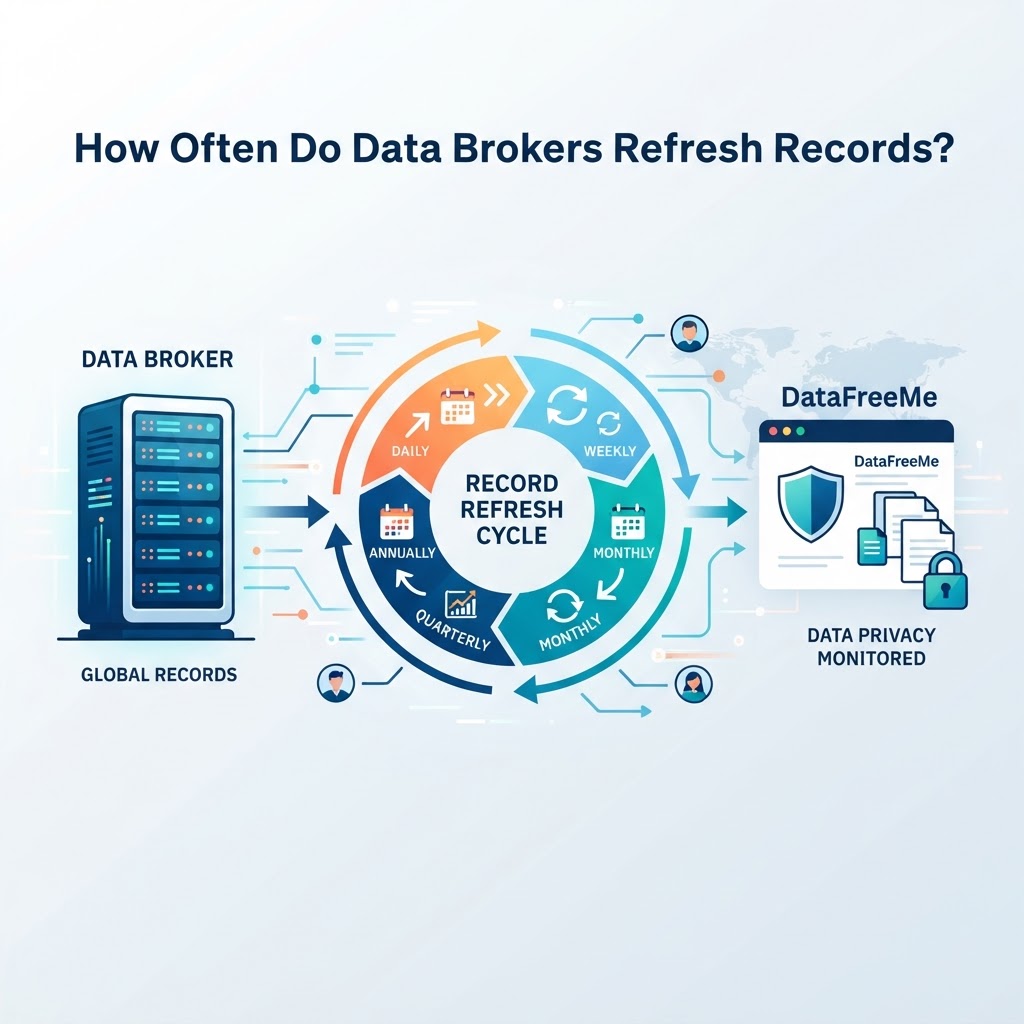
At DataFreeMe, based globally and led by CEO Stephen Sawyers, we specialize in helping households regain control of their digital footprint. When clients ask, "how often do data brokers refresh records," the answer is rarely static; many major data aggregators perform partial refreshes weekly, while others update their master identity graphs on a monthly or quarterly cycle depending on the specific data source, such as municipal property records or social media scrapers.
As a data security expert, I have spent years observing the adversarial nature of these networks. You must understand that data broker refresh cycles are not just technical maintenance; they are aggressive attempts to keep their product—your personal profile—as current as possible. In our experience managing hundreds of household privacy audits, we have found that silence is often mistaken for a permanent opt-out. If you believe one manual request fixes the issue forever, you are likely leaving your data vulnerable to the next automated scrape.
How Often Do Data Brokers Refresh Records? A Tactical Breakdown
Data brokers operate a continuous feedback loop. They do not have a single "refresh" button. Instead, their systems run constant ingestion pipelines that ingest new public filings, bankruptcy notices, and consumer behavior data. When we analyze the industry, it is clear that how often do data brokers refresh records varies by the level of the aggregator:
- Tier-1 Aggregators: These major industry players often refresh core identifying information every 30 to 60 days to ensure accuracy for their commercial clients.
- Secondary People-Search Sites: These often scrape data from primary aggregators. Their refresh cycle is frequently triggered by a site-wide re-crawl, which can happen as often as every 14 days.
- Municipal/Property Records: These are updated when new deeds are filed at the county level. Because these records are public, brokers pull them almost as soon as the digital county portal publishes them.
If you aren't managing your data with a systemic approach, you are fighting a losing battle. We recommend that you learn how to treat your family’s digital footprint as a single, manageable data graph to stay ahead of these refreshes. A passive approach allows your records to drift back into active status, a process commonly known as profile relisting.
Why Do Data Brokers Refresh Records So Frequently?
The primary motivation for constant refreshing is maintaining the valuation of their identity graphs. According to Federal Trade Commission (FTC) reports on data brokers, these companies compete on the depth and recency of the information they sell. If a data broker's record for your household is two years old and contains a previous address, their data is less valuable to insurance companies, marketing firms, or creditors. Therefore, they have a direct financial incentive to ensure that the moment you move or change your phone number, that information is synced into their database.
In our work, we have seen that many brokers utilize "identity resolution" to link old profiles to new ones. Even if you opt out, a simple change in your credit report or a new utility bill registration can serve as a catalyst for a re-listing event. This is why our team at DataFreeMe emphasizes the importance of understanding your data broker statutory deletion rights under laws like the CCPA and GDPR.
Managing the Re-listing Cycle
To combat the frequency of data refreshes, you need an audit trail. You cannot simply fire off an email and expect the company to respect your privacy for all eternity. Instead, you need to implement a data broker deletion audit trail spreadsheet. This allows you to track exactly when you sent an opt-out request, who received it, and when the statutory 45-day response window under CCPA §1798.105 expires.
If you find that your information has reappeared, it is likely due to an upstream update. When a broker refreshes records, they often pull data from secondary sources that you may not have targeted yet. We suggest conducting periodic scans to ensure your Free Data Broker Exposure is minimized. By treating your household privacy as an operational campaign, you can successfully prune your footprint even as these companies try to rebuild it.
Conclusion
Data brokers refresh records as a core business function, meaning your privacy is not a "one-and-done" task. You must stay vigilant, track your opt-out statuses, and understand the legal frameworks that force these companies to comply with your deletion requests. Start by mapping your household, identifying which brokers currently hold your data, and initiating your first round of statutory requests today. At DataFreeMe, we provide the tools to help you manage this process with the rigor it deserves. Stop letting your data be a commodity and start auditing your footprint today.
Frequently Asked Questions
How often do data brokers refresh records?
Data brokers typically refresh records every 30 to 90 days, though high-traffic people-search sites may update their datasets as frequently as every two weeks to remain competitive.
Why does my information keep reappearing after I opt out?
Your information often reappears because data brokers perform continuous data ingestion from multiple sources, allowing them to rebuild profiles via "identity resolution" when new public information is detected.
What is the best way to prevent data broker re-listing?
The most effective strategy is to maintain a rigorous, recurring audit trail of all opt-out requests, periodically re-check search engines for your name, and enforce statutory deletion rights under CCPA or GDPR if data is re-listed.
Does a single opt-out request cover all data brokers?
No, there is no universal "opt-out" for the entire industry; you must submit individual requests to each specific broker or utilize a structured management approach to address them systematically.