
People Search vs Data Broker Aggregator Differences
Understand the critical people search vs data broker aggregator differences to effectively prune your household's data footprint at the source.
In short: people search vs data broker aggregator differences is worth getting right. Here's what matters most for your situation.
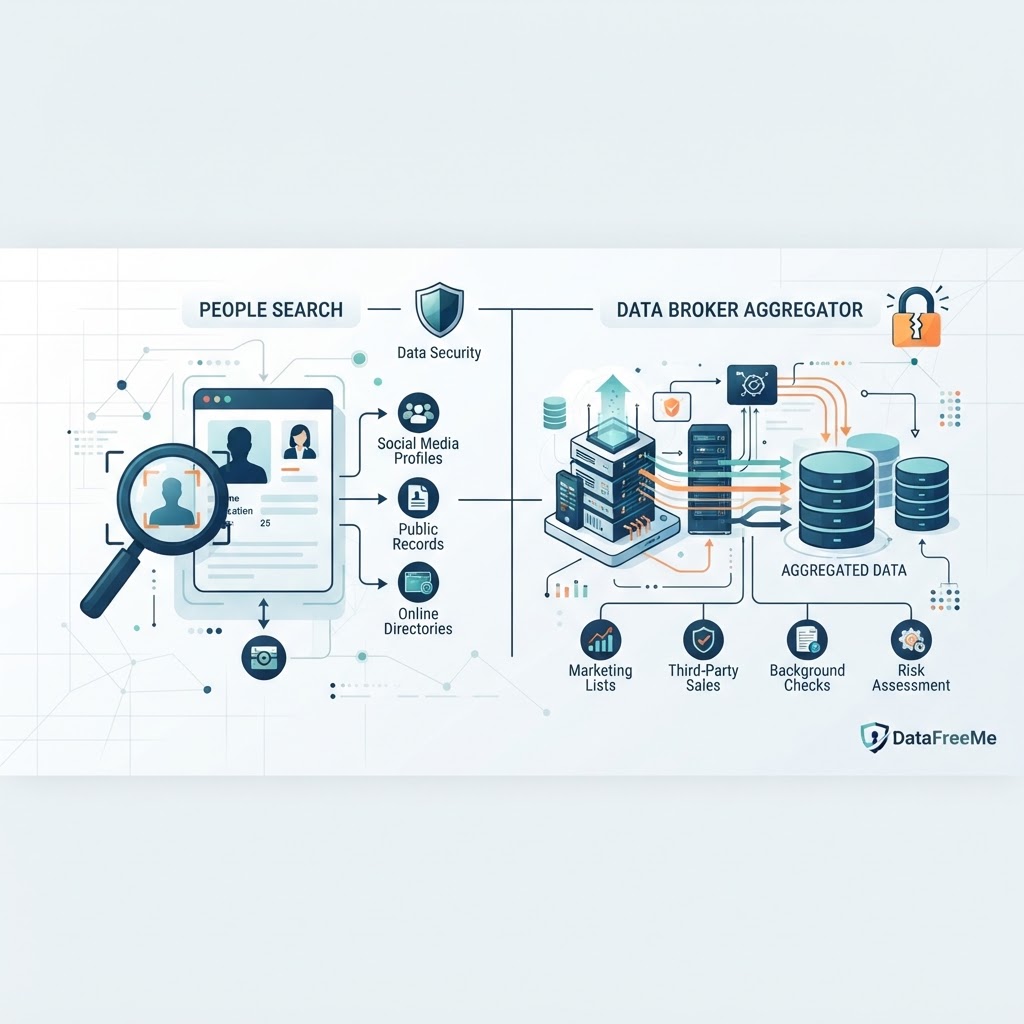
People search sites and upstream data broker aggregators serve distinct roles in the surveillance capitalism ecosystem, and understanding these people search vs data broker aggregator differences is vital for any household privacy operation. At DataFreeMe, we specialize in providing global users with the tactical frameworks needed to prune their digital footprint from these vast networks. I am Stephen Sawyers, CEO of DataFreeMe, and as a data security expert, I have spent years mapping the relational graphs that connect secondary brokers to primary data aggregators.
To put it simply, a people search site is a consumer-facing interface designed to display personal profiles for a fee, while an upstream data broker aggregator is a wholesale distributor that collects, cleans, and sells data in bulk to hundreds of downstream services. While you might find your home address on a search site, that data likely originated at an aggregator that processes billions of records daily. Recognizing these people search vs data broker aggregator differences is the first step in moving from reactive opt-outs to a proactive, systemic suppression strategy.
What are the primary people search vs data broker aggregator differences?
In our experience at DataFreeMe, most users focus exclusively on the sites they can see—the people search engines that show their name and phone number. However, these are merely the tip of the iceberg. The real structural threat lies in the upstream aggregators. When you compare the two, the functional gaps become clear:
- Visibility and Intent: People search sites are designed for easy user access to drive ad revenue and subscription sales. Aggregators are often invisible, operating via API-to-API transfers without a public-facing website.
- Data Volume and Recency: Aggregators maintain the "master" record. If you delete your information from a people search site but fail to address the upstream aggregator, the site will likely re-populate your record within weeks.
- Legal Compliance Paths: While both are subject to CCPA §1798.105 and GDPR Article 17, the enforcement mechanisms differ. For more details on these rights, consult our guide on CCPA vs GDPR: Which Deletion Right Are You Using?
How do aggregators feed the people search ecosystem?
Data aggregators act as the "source of truth" for the data industry. They ingest data from public records, credit reporting agencies, utility providers, and social media platforms. Once this data is aggregated and normalized, it is sold to hundreds of downstream brokers. This is why a single opt-out request is rarely sufficient. Because the data is constantly refreshed, your household's digital footprint is a living graph that requires consistent monitoring. If you leave one family member in the system, they act as an anchor that allows brokers to re-link your household data. We detail this relational complexity in our guide on what data brokers know about your family.
Understanding these people search vs data broker aggregator differences means shifting your focus toward upstream suppression. If you successfully remove your data from the central aggregator, you effectively poison the well for every downstream site that relies on that feed. Our team emphasizes an audit-driven approach: maintain a log of every request, verify your removal status at the 45-day mark, and treat your privacy as an ongoing technical operation rather than a one-time chore.
The mechanics of these removals are often intentionally difficult. Some brokers employ "dark patterns"—deceptive UI/UX designs intended to discourage or prevent you from exercising your rights. To navigate this, you should learn how to bypass data broker opt-out friction using a systematic, audit-driven approach. By treating every request as a verifiable consumer request under the law, you increase your leverage and compel compliance.
For those managing a household, the stakes are higher. Household data is often grouped together by address, meaning your partner or children's records are frequently tethered to your own. You must consider the entire household a single data entity. If you are ready to begin, start by using our free data broker exposure scan to see which aggregators currently hold your household's most sensitive contact details. From there, you can begin the work of systematic pruning.
How can you effectively manage these privacy threats?
Managing the people search vs data broker aggregator differences is not about chasing every individual site. Instead, it is about building a workflow. We recommend a batch-processing system for your removals. By tracking the dates you submitted your requests and the specific statutory grounds for deletion (such as the California Delete Act), you hold the data ecosystem accountable. Silence from a broker is not compliance; it is a signal to escalate your inquiry.
As you continue your privacy journey, remember that transparency and persistence are your greatest assets. Record every interaction, log every receipt, and refuse to accept automated "request received" emails as the end of the process. If you encounter a wall, refer back to the verifiable consumer request requirements to ensure you are framing your demand in a way that legally forces a response.
For further tactical guidance on securing your family's data, browse our privacy blog. We provide the tools and logic required to reclaim your digital sovereignty from the systems that trade in your personal history. Let us turn the tide on systemic surveillance—one batch of opt-outs at a time.
Frequently Asked Questions
What are the primary people search vs data broker aggregator differences?
People search sites are consumer-facing platforms that display your personal information, while data broker aggregators are wholesale entities that collect and sell your data to other companies. Aggregators feed the information that appears on people search sites, making them the primary source you need to prune.
Why does my data keep reappearing after I opt out?
Your data likely reappears because you have opted out of the downstream people search site but not the upstream aggregator. Because the aggregator remains the source of truth, it continuously updates the people search site with your data until you remove your information at the source.
Is it better to focus on people search sites or aggregators?
You should prioritize removing your data from major upstream aggregators first, as this creates a "bottleneck" effect that prunes your data from hundreds of downstream sites simultaneously. Targeting only consumer-facing sites is inefficient and often ineffective for long-term household privacy.