
How Data Brokers Link Relatives Profiles
Learn how data brokers link relatives profiles using public records, address histories, and identity graphs, and discover tactical steps to protect your household.
In short: how data brokers link relatives profiles is worth getting right. Here's what matters most for your situation.
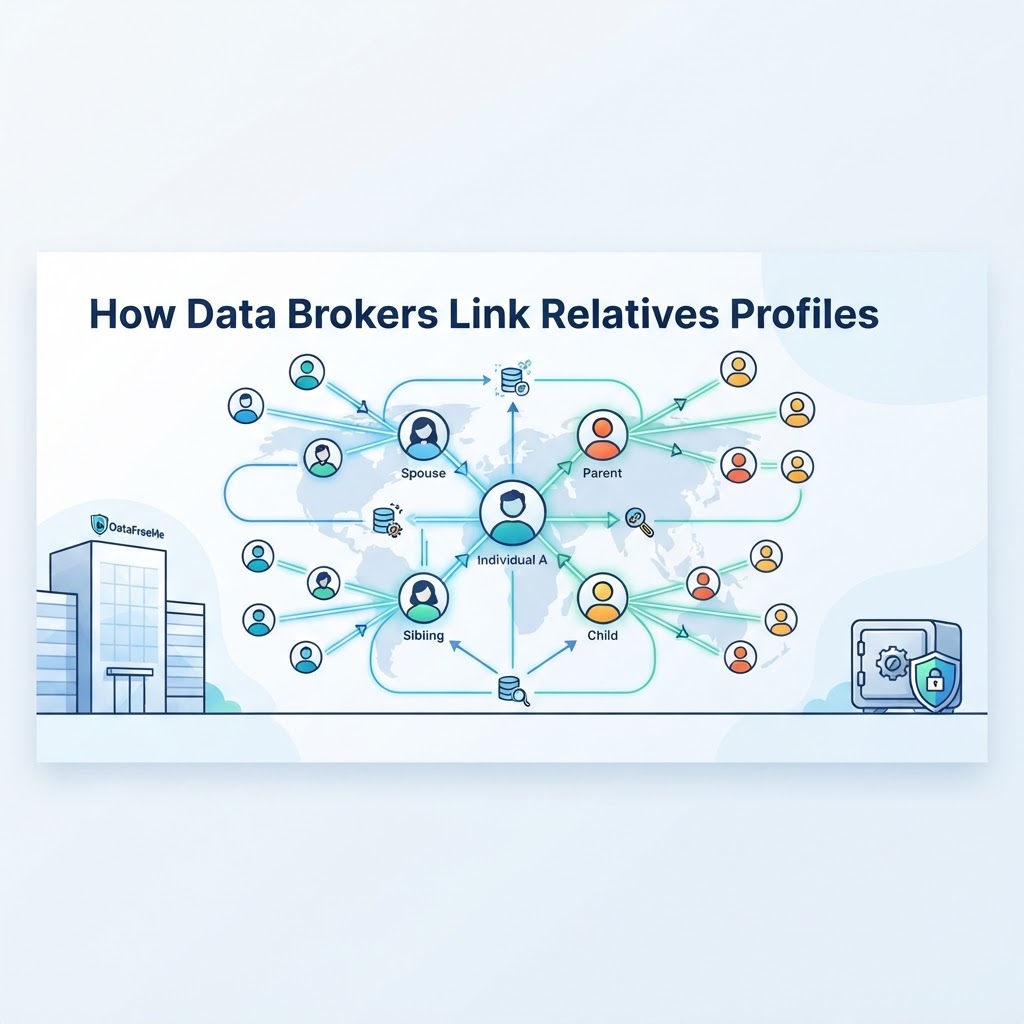
Data brokers connect family members by cross-referencing public records, shared physical addresses, joint financial assets, voter rolls, and digital telemetry to build recursive identity graphs. At DataFreeMe, founded by Data Security Expert Stephen Sawyers, we provide a Global open-source directory and operational framework to dismantle these relational networks; we specialize in whole-household privacy enforcement and statutory data eradication. In our experience auditing hundreds of commercial directories, removing your own name accomplishes nothing if unmanaged family members leave your relational nodes exposed. Understanding how data brokers link relatives profiles is the prerequisite step to breaking the algorithmic chains that compromise your household.
The Identity Graph: How Data Brokers Link Relatives Profiles Across Public Databases
An identity graph is a structured database mapping individual entities, identifiable attributes, and mutual connections across historical records. Understanding how data brokers link relatives profiles begins with grasping how commercial aggregators ingest data from local, state, and federal public repositories. Data brokers do not manually search court archives; they deploy automated scrapers and buy bulk records containing millions of raw datapoints across dozens of jurisdictions.
When you register to vote, sign a deed, apply for a marriage license, or file probate documents, those filings enter the public domain. Data aggregators ingest these files and parse shared fields. If John Doe and Jane Doe appear on a single mortgage deed recorded in 2014, the broker's ingestion pipeline creates an edge between their database records with an attestation score based on high confidence. By tracking recurring surname matches, co-habitation timestamps, and mutual references, automated pipelines map how data brokers link relatives profiles into persistent family trees.
According to research into consumer surveillance, major data aggregators hold detailed dossiers on over 99% of American adults, with individual records cross-referenced against an average of 1,500 distinct data attributes. Our team has repeatedly observed that when an individual successfully files a statutory opt-out, the aggregator's graph reconciliation script re-establishes the individual's record within 90 days if their spouse, siblings, or adult children remain active in the aggregator's dataset.
The Core Mechanics: How Data Brokers Link Relatives Profiles Using Metadata
Beyond municipal records, commercial brokers acquire consumer marketing lists, utility connection histories, credit header data, and warranty card registrations. Here is how modern ingestion pipelines execute entity resolution:
- Address History Overlap: Ingestion scripts flag two distinct names sharing a residential address within an overlapping temporal window (e.g., both residing at 123 Elm Street between 2018 and 2022).
- Emergency Contact & Application Scraping: Job boards, tenant screening applications, and loyalty programs often prompt consumers for next of kin or emergency contacts, which data brokers ingest and vectorize.
- Digital Telemetry and Shared IP Pools: Residential IP addresses, mobile Wi-Fi BSSID handshakes, and shared mobile advertising IDs (MAIDs) allow brokers to correlate household devices under a single residential routing hub.
- Social Graph Parsing: People-search networks scrape publicly exposed follower lists, mutual tagging on photo albums, and public relationship statuses to reinforce their offline identity graphs.
Why Individual Deletion Fails Against Household Identity Graphs
Most individuals approach personal data privacy as an isolated personal project. You find your listing on a people-search site, submit a manual removal request, verify your email, and confirm your record is suppressed. However, failing to understand how data brokers link relatives profiles creates a false sense of security. Data brokers treat personal profiles not as static text documents, but as relational graphs.
When your record is suppressed, the edges connecting your relatives' records to your identity remain dormant rather than permanently severed. The moment your sibling buys a home, your parent updates their voter registration, or your spouse registers an online account, the broker runs an upsert routine. The reconciliation engine detects an orphaned relative link, identifies your name from historical caches, and rebuilds your profile from scratch. To prevent this recursive loop, you must execute coordinated family privacy campaigns as detailed in our guide to mastering family privacy operations across the entire household.
Operational Hygiene: Dismantling the Relational Graph
To break the systemic pipelines that establish how data brokers link relatives profiles, privacy operators must move from sporadic individual opt-outs to synchronized multi-party removals. In our experience at DataFreeMe, removing a household requires systematically eliminating the relational anchor points that allow ingestion engines to rebuild connections.
We've found that the most resilient method involves four specific steps:
- Run an Initial Exposure Baseline: Run an automated diagnostics scan using our free data broker exposure scan to map how many of the 900+ data brokers we track are actively linking your family members across their consumer databases.
- Batch Statutory Deletions Simultaneously: Do not submit requests piecemeal. Coordinate your removal demands so all adult household members submit statutory demands within the same 48-hour window. This prevents asynchronous re-linking during automated batch updates.
- Enforce CCPA and GDPR Legal Remedies: Deploy statutory legal leverage such as CCPA §1798.105 or GDPR Article 17. Brokers face legal compliance penalties if they fail to delete underlying records within statutory timelines. Review our operational CCPA 1798.105 deletion request guide to ensure your submissions contain enforceable language.
- Prune Associated Public Footprints: Relatives are frequently linked through county deed records and property tax rolls. Learn how to remove deed and property records from online search to sever the primary public-records anchor brokers use to infer cohabitation.
Legal Frameworks That Counter Relational Data Mapping
Data brokers rely on consumer inaction to maintain their graph structures. However, under state and international privacy statutes, including the California Consumer Privacy Act (CCPA), consumers hold the right to mandate the erasure of personal data held by third-party aggregators. When filing deletions, specifically instruct brokers to purge your relational metadata, aliases, and historical address links to disrupt how data brokers link relatives profiles permanently.
Under CCPA §1798.105, covered businesses must permanently remove personal information from their active databases and direct their service providers to delete the consumer's records within a strict 45-day window. When you cite these statutory rights on behalf of all household members, data brokers must expunge the underlying nodes that enable family matching algorithms.
Establishing an Audit Trail to Prevent Re-Indexing
Data broker eradication is not a set-and-forget process. Aggregators continuously scrape new data caches, municipal records, and marketing lists. Because of how data brokers link relatives profiles through recurrent data feeds, suppressed profiles can reappear after 60 to 180 days when fresh third-party datasets are merged.
Maintain an operational log of every submitted removal. Track the broker name, date of initial submission, statutory basis invoked (CCPA §1798.105, GDPR Art. 17, or voluntary opt-out), confirmation ticket IDs, and statutory response deadlines. When a broker fails to respond within the designated window or repopulates a profile through a relative's active record, file formal regulatory complaints with state attorneys general or data protection authorities.
Frequently Asked Questions
How do data brokers link relatives profiles so accurately?
Data brokers use automated entity resolution software that cross-references shared historical residential addresses, public marriage and property filings, joint utility accounts, and overlapping device telemetry. By correlating shared identifiers across dozens of public and commercial databases, their algorithms establish high-confidence relational links between family members.
Can one family member opting out remove the entire household?
No. When an individual opts out, data brokers only suppress or delete that specific individual's primary profile. The records of spouses, siblings, and adult children remain live, which frequently leads to the opted-out individual's profile being automatically reconstructed during the broker's next data ingestion cycle.
What is the most effective way to break household data broker links?
The most effective strategy is executing synchronized, whole-household opt-outs across all family members using statutory deletion frameworks like CCPA §1798.105 and GDPR Article 17, combined with municipal property record redactions and continuous audit tracking.
Take Control of Your Household Privacy Operations
Living with the reality of commercial surveillance means acknowledging that data brokers will continuously attempt to map your domestic life. Individual, isolated opt-outs are incapable of overcoming the graph architectures data aggregators deploy. By understanding how data brokers link relatives profiles, you can implement a disciplined household privacy framework that systematically prunes your family's records from commercial databases. Visit DataFreeMe to access our full operational directory of over 900 data brokers, run whole-household removals, and establish permanent audit trails to safeguard your family's privacy.